|
Do you believe there is a U.S. government cover-up surrounding 9/11? (pg. 185)
|
View this Thread in Original format
| {b.s.e.} |
| quote: | Originally posted by Q5echo
read, then think about what you just accepted as "truth".
2000*F at 6 hours? think about that for a minute. |
Underwriters Laboratories (UL), certified the steel for the WTC. They asserted that it would take 6 hours at 2000*F to weaken the steel sufficiently to cause collapse. |
|
|
| Q5echo |
| quote: | Originally posted by {b.s.e.}
Underwriters Laboratories (UL), certified the steel for the WTC. They asserted that it would take 6 hours at 2000*F to weaken the steel sufficiently to cause collapse. |
i don't not believe you persay. source? |
|
|
| jerZ07002 |
| quote: | Originally posted by {b.s.e.}
(7) the destruction of the South Tower in 10 seconds and of the North in 11 iseven faster than free fall with only air resistance, which would have taken 12seconds, which, as Judy Wood (Ph.d in mechanical engineering) has emphaized, is an astounding result that wouldhave been impossible without extremely powerful explosives;
|
that makes no sense at all. if free fall with only air resistance would take 12 seconds, then no amount of explosives could accelerate that process; only the elimination of air resistance could reduce the time to below 12 seconds (if that stupid theory is to be believed).
are you suggesting that somehow the US government can change the laws of physics? |
|
|
| {b.s.e.} |
| quote: | Originally posted by jerZ07002
that makes no sense at all. if free fall with only air resistance would take 12 seconds, then no amount of explosives could accelerate that process; only the elimination of air resistance could reduce the time to below 12 seconds (if that stupid theory is to be believed).
are you suggesting that somehow the US government can change the laws of physics? |
you`re quite right. looking further, it is discovered that it falls in about 16 seconds. as evaluated by seismic data
10:28:23 North Tower starts to crumble
10:28:31 Rubble starts to hit the ground (start of big signal)
10:28:36 The heaviest rubble hits the ground (peak of big signal)
10:28:39 Most heavy rubble has reached the ground (end of big signal)
still pretty peculiar. |
|
|
| Q5echo |
| quote: | Originally posted by {b.s.e.}
you can believe when i say it`s spelled per se. :wtf: |
i'm not writing a frikken law thesis here.
neither of these support your claim.
in fact, you've seen video evidence to their contrary of the actual external steel collumns buckle inward just prior to collapse. |
|
|
| {b.s.e.} |
| quote: | Originally posted by Q5echo
i'm not writing a frikken law thesis here.
neither of these support your claim.
in fact, you've seen video evidence to their contrary of the actual external steel collumns buckle inward just prior to collapse. |
We know that the steel components were certified to ASTM E119. The time temperature curves for this standard require the samples to be exposed to temperatures around 2000F for several hours. And as we all agree, the steel applied met those specifications. Additionally, I think we can all agree that even un-fireproofed steel will not melt until reaching red-hot temperatures of nearly 3000F (2). Why Dr. Brown would imply that 2000F would melt the high-grade steel used in those buildings makes no sense at all.
However the summary of the new NIST report seems to ignore your findings, as it suggests that these low temperatures caused exposed bits of the building’s steel core to "soften and buckle." (5) Additionally this summary states that the perimeter columns softened, yet your findings make clear that "most perimeter panels (157 of 160) saw no temperature above 250C." To soften steel for the purposes of forging, normally temperatures need to be above1100C (6). However, this new summary report suggests that much lower temperatures were be able to not only soften the steel in a matter of minutes, but lead to rapid structural collapse.
---------------------------------
that sums it up pretty well.. taken in pieces from Globalresearch link. |
|
|
| pkcRAISTLIN |
| quote: | Originally posted by {b.s.e.}
Underwriters Laboratories (UL), certified the steel for the WTC. They asserted that it would take 6 hours at 2000*F to weaken the steel sufficiently to cause collapse. |
did they now? or did one of their employ just make some figures up?
| quote: |
We know that the steel components were certified to ASTM E119. The time temperature curves for this standard require the samples to be exposed to temperatures around 2000F for several hours. And as we all agree, the steel applied met those specifications. Additionally, I think we can all agree that even un-fireproofed steel will not melt until reaching red-hot temperatures of nearly 3000F (2). Why Dr. Brown would imply that 2000F would melt the high-grade steel used in those buildings makes no sense at all.
This story just does not add up. If steel from those buildings did soften or melt, I’m sure we can all agree that this was certainly not due to jet fuel fires of any kind, let alone the briefly burning fires in those towers. That fact should be of great concern to all Americans. Alternatively, the contention that this steel did fail at temperatures around 250C suggests that the majority of deaths on 9/11 were due to a safety-related failure. That suggestion should be of great concern to my company.
This all sounds very scientific, and so when Avery says, "Days after writing this letter, Kevin Ryan was fired from his position", it sure sounds like he got canned for whistle-blowing.
However, the next two paragraphs of Ryan's letter, which Avery does not show, may give us something of a hint as to why he was terminated:
There is no question that the events of 9/11 are the emotional driving force behind the War on Terror. And the issue of the WTC collapse is at the crux of the story of 9/11. My feeling is that your metallurgical tests are at the crux of the crux of the crux. Either you can make sense of what really happened to those buildings, and communicate this quickly, or we all face the same destruction and despair that come from global decisions based on disinformation and “chatter”.
Thanks for your efforts to determine what happened on that day. You may know that there are a number of other current and former government employees that have risked a great deal to help us to know the truth. I've copied one of these people on this message as a sign of respect and support. I believe your work could also be a nucleus of fact around which the truth, and thereby global peace and justice, can grow again. Please do what you can to quickly eliminate the confusion regarding the ability of jet fuel fires to soften or melt structural steel.
Global peace and justice? Sure sounds to me like Ryan's the one trying to make a political point here. Note that the letter is written over 2 years after 9-11--after the Iraq invasion and also following Bush's victory over John Kerry in the 2004 Presidential Election.
This article indicates that Ryan was fired for lying about key facts in the letter.
But his allegations drew a sharp rebuke from UL, which said Ryan wrote the letter "without UL's knowledge or authorization." The company told The Tribune "there is no evidence" that any firm tested the materials used to build the towers.
"UL does not certify structural steel, such as the beams, columns and trusses used in World Trade Center," said Paul M. Baker, the company's spokesman.
Ryan was fired, Baker said, because he "expressed his own opinions as though they were institutional opinions and beliefs of UL."
"The contents of the argument itself are spurious at best, and frankly, they're just wrong," Baker said.
And:
UL moved immediately to discredit Ryan.
The company said Ryan "was not involved in that work and was not associated in any way with UL's Fire Protection Division, which conducted testing at NIST's request."
The company said it "fully supports NIST's ongoing efforts to investigate the WTC tragedy. We regret any confusion that Mr. Ryan's letter has caused 9/11 survivors, victims' families and their friends."
"We prefer to base our conclusions, and NIST would say the same, on science rather than speculation," Baker said. "We anxiously await the outcome of the NIST investigation."
James suggested I check out the Wikipedia entry on Ryan. Guess what his area of expertise was at Underwriters Laboratories?
Kevin Ryan is a former Site Manager for Environmental Health Laboratories in South Bend, Indiana, a subsidiary of Underwriters Labs(UL) responsible for water testing.
Steel, water, what's the difference? James also points out that Ryan's argument about steel melting in the fire is a straw man, since that is not what the experts concluded:
"I have never seen melted steel in a building fire," says retired New York deputy fire chief Vincent Dunn, author of The Collapse Of Burning Buildings: A Guide To Fireground Safety. "But I've seen a lot of twisted, warped, bent and sagging steel. What happens is that the steel tries to expand at both ends, but when it can no longer expand, it sags and the surrounding concrete cracks."
"Steel loses about 50 percent of its strength at 1100°F," notes senior engineer Farid Alfawak-hiri of the American Institute of Steel Construction. "And at 1800° it is probably at less than 10 percent." NIST also believes that a great deal of the spray-on fireproofing insulation was likely knocked off the steel beams that were in the path of the crashing jets, leaving the metal more vulnerable to the heat. |
http://screwloosechange.blogspot.co...in-ryan-of.html |
|
|
| Q5echo |
again, your claims aren't seen here.
| quote: | Originally posted by {b.s.e.}
We know that the steel components were certified to ASTM E119. The time temperature curves for this standard require the samples to be exposed to temperatures around 2000F for several hours. And as we all agree, the steel applied met those specifications. Additionally, I think we can all agree that even un-fireproofed steel will not melt until reaching red-hot temperatures of nearly 3000F (2). Why Dr. Brown would imply that 2000F would melt the high-grade steel used in those buildings makes no sense at all
However the summary of the new NIST report seems to ignore your findings, as it suggests that these low temperatures caused exposed bits of the building’s steel core to "soften and buckle." (5) Additionally this summary states that the perimeter columns softened, yet your findings make clear that "most perimeter panels (157 of 160) saw no temperature above 250C." To soften steel for the purposes of forging, normally temperatures need to be above1100C (6). However, this new summary report suggests that much lower temperatures were be able to not only soften the steel in a matter of minutes, but lead to rapid structural collapse.
---------------------------------
that sums it up pretty well.. taken in pieces from Globalresearch link. |
this has been gone over a million times here. steel doesn't have to be brought to its melting point of 2500 degrees for it to weaken, especially under severe load.
this steel is at 1500 degrees.
 |
|
|
| CB_Brooklyn |
| quote: | Originally posted by {b.s.e.}
Underwriters Laboratories (UL), certified the steel for the WTC. They asserted that it would take 6 hours at 2000*F to weaken the steel sufficiently to cause collapse. |
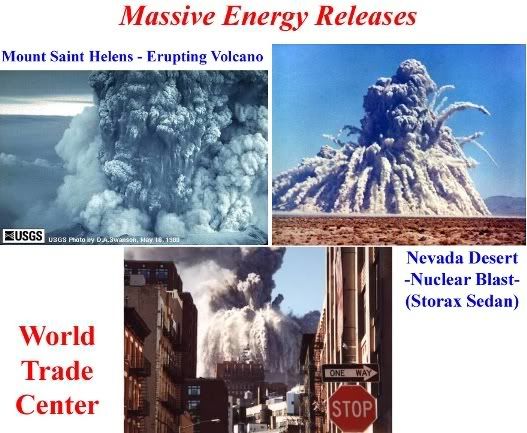
Did the Towers really "collapse"? Look at these pictures:

 |
|
|
| pkcRAISTLIN |
| quote: | Originally posted by CB_Brooklyn
Did the Towers really "collapse"? Look at these pictures:
|
yes, quite obviously the towers were a volcano. |
|
|
| Lebezniatnikov |
| quote: | Originally posted by pkcRAISTLIN
yes, quite obviously the towers were a volcano. |
Oh yeah? PROVE IT DIDN'T HAPPEN THAT WAY! |
|
|
|
|

