Hacker Creates a Proxy Server For Siri To Easily Add New Functionality; Demos Controlling a Wi-Fi Thermostat [Updated]
Few days back, folks at Applidium had cracked Siri's security protocol and the format it uses to communicate with Apple's iPhone 4S.
Using that knowledge, hacker who goes by the Twitter handle plamoni has created a proxy server for Siri - Apple's revolutionary voice activated personal assistant feature called Siri Proxy. He says that the idea behind the proxy server is to make it easy for developers to add functionality to Siri.
He has released the source code of the proxy server along with the instructions on how to set it up on social coding site - GitHub.
He has also demonstrated how the proxy server works by creating a plugin to control a Wi-Fi thermostat, which responds to command such as "What's the status of the thermostat?", or "Set the thermostat to 68 degrees", or even "What's the inside temperature?"
You can checkout the impressive video demonstration of using Siri to control the thermostat using the proxy server:
The ability to add functionality to Siri on your own does seem very cool. It will be interesting to see what other fun things we get to see using the Siri proxy.
Update:
Pete (Twitter handle plamoni) who has developed the Siri Proxy server has clarified in the comments section that this hack doesn't need a jailbroken iPhone:
I’m the creator of this particular hack, and I can assure you, it doesn’t require the iPhone to be jailbroken. My iPhone 4S is not jailbroken. The only action I needed to take on my iPhone was to install my fake Root CA. Which you can do without jailbreaking. Everything else is done outside of the phone, so it requires no jailbreaking or code to be placed on the phone itself.
Thanks Pete!
In the FAQ section of the SiriProxy project page on GitHub, he has also answered the question about whether this hack will let you run Siri on my iPhone 4, iPod Touch, iPhone 3G, Microwave, etc.
Short answer: No.
Longer answer: While this doesn't let you do such a thing, it could HELP with such a thing. For instance, if you get Siri installed on your iPhone 4 (don't ask me how to do this, I really don't know), and you get someone to give you a valid iPhone 4S UDID (don't ask me for mine, I will ignore your request), you could use this proxy in order to substitute the valid UDID for your device's invalid UDID. It would be pretty trivial. Of course, that would allow anyone with access to the proxy use your UDID, so I'd recommend against that sort of action on anything externally accessible without performing some sort of authentication (might I suggest, checking the phone's UDID? hehe).
You can checkout Siri Proxy's GitHub page for more details.
Occupy Flash calls on users to remove Adobe's player from their computers
Adobe may have discontinued development of its Flash Player for mobile devices and hinted at backing away from Flash on the desktop, but an anonymous group calling itself Occupy Flash wants action now. Focused primarily on desktop Flash, the group is asking the world to boldly uninstall the multimedia player from desktops and laptops. It argues that as long as Flash — a proprietary "fossil," in its words — is ubiquitous on computers it will continue to see development, despite the availability of open standards like HTML5. It holds up the years-long dominance of Internet Explorer 6 as an object lesson, and acknowledges that while users may have to go without certain websites or Flash games in the short term, "the more of us who run browsers that don't support Flash, the quicker that pain will subside." It's estimated that Flash Player is currently installed on 95 percent of desktop browsers, but with Adobe now aiming its development tools towards HTML5 and Air apps, it may not be too long before Flash becomes the one percent instead. Check out the source below to see if you're ready for your browser to join the movement.
Pett
quote:
Originally posted by Nerologic
Im out of the loop again...is there and untethered jailbreak for the 4? And is there any jb for the 4S yet? Or are they waiting for the next OS?
EDIT:
Still tethered :(
semi-tethered, reboots are good to go now
E2EK1EL
Flash for Android not quite dead yet, will land on Ice Cream Sandwich by year's end
We're not sure you'd necessarily consider this a bad thing, but Google's new world-beating Android phone, the Galaxy Nexus, comes without a preinstalled Flash Player and offers no option to download or install it from the Market. This is because, says Google, Adobe needs to update the software for Ice Cream Sandwich, which has yet to happen.
That puts us in rather a tricky situation since Adobe recently_halted development of Flash_for mobile platforms, although SlashGear — who first spotted the issue — has a statement from Google saying that "as far as we know, Adobe will support Flash for ICS." So Ice Cream Sandwich will likely still get the rich media capabilities that Flash provides, though we imagine it'll be the last new...
European Galaxy Nexus owners complain of erratic volume issue (video)
Samsung's new flagship smartphone isn't having the smoothest of beginnings. The strange ROM that cropped up a few days ago turned out to be an isolated incident, but now the forums are abuzz with an audio issue that looks a lot more serious. Essentially, the handset's volume control appears to have a mind of its own, flitting randomly between mute, full blast and everything in between. The problem has so far only been observed on European phones using the GSM 900MHz band, and it's exacerbated by the cellular modem either boosting itself in a low reception area or switching between 2G and 3G connections. A user poll over at the XDA Developers forum suggests around 60 percent of owners have experienced the fault. There's a video after the break, complete with a disappointed kid in the background bugging his dad for answers.
Galaxy Nexus volume bug seemingly reproduced by holding another phone nearby
Earlier today, we reported that some British owners of Galaxy Nexuses were voicing concerns about the volume spontaneously going to zero; at the time, we'd hoped that it was a software issue, but a new video has us worried that there might be something deeper involved. A YouTuber has uploaded a brief video of a Galaxy Nexus in bootloader mode that appears to be cycling through the menu itself when another phone is brought near — in bootloader mode, the menu is actuated by way of the volume rocker, so there's your connection. The phone next to the Galaxy is allegedly connected to a 900MHz 2G network, which appears to be the band where the phones are having the problem. It's way too early to speculate whether Google and Samsung will be able to patch this up with an over-the-air firmware update alone, but the fact that this can be reproduced simply by holding another phone nearby — all the way up in the lightweight bootloader mode, no less — is cause for alarm.
Users have discovered that they can temporarily stop the issue by locking the phone into 3G mode, but depending on where you live and where you travel, that may not be an option. The silver lining for North Americans is that there's no evidence yet to suggest that this bug (assuming it's a real bug) will affect either the CDMA / LTE variant or the GSM variant when operating on US and Canadian bands; we certainly haven't seen anything like this on our review unit, but we'll be keeping an eye on it as it develops.
E2EK1EL
Android Malware Has Increased Almost Five-Fold Since July; While iOS Has Been ‘Untouched’
A report by the Juniper Global Threat Center has found that Android malware has increased by 472% since July of this year. They also concluded that this October and November were the months that showed the fastest growth of mobile malware on Android ever.
Juniper’s report mentioned that between 2009 and the summer of 2010, there was a four-fold increase in malware. This was still outdone by a recent epidemic in Google’s Android Market in the past few months. August showed an 10% increase, September jumped 18% over that, and October was another 110% over that. November hasn’t ended yet and there’s already a 111% increase of malware.
The report looks at the differences between Apple’s App Store and Google’s Market and blames the open-ended nature of the latter, as well as the lack of any code-signing and checking process.
“These days, it seems all you need is a developer account, that is relatively easy to anonymize, pay $25 and you can post your applications,” wrote Juniper in its report. “With no upfront review process, no one checking to see that your application does what it says, just the world’s largest majority of smartphone users skimming past your application’s description page with whatever description of the application the developer chooses to include.”
This flies in the face of many who praise the Android Market’s “openness,” as opposed to Apple’s stringent app review process. While Apple’s model isn’t flawless – Charlie Miller’s app that demoed a vulnerability was approved, after all – it’s still very malware-free, especially in comparison to the Android Market. According to AppleInsider, MacAfee also found Android to be malware-ridden but that iOS was “untouched.”
The situation seems to be a dire one as threats become more and more complex.
In addition to an increase in the volume, the attackers continue to become more sophisticated in the malware they write. For instance, in the early spring, we began seeing Android malware that was capable of leveraging one of several platform vulnerabilities that allowed malware to_gain root access_on the device, in the background, and then install additional packages to the device to extend the functionality of the malware.
In addition to this, 55% of threats are spyware-based attacks that send private data and take control of devices, while 44% are trojans that send text messages to services that charge the user.
(It's dangerous to have non certified apps in a ecosystem)
Research In Motion’s latest run of BlackBerry smartphones was reportedly well-received early on, with checks from a number of sources having indicated strong upgrade sales for several phone models. Demand has apparently been waning lately however, as strong competition from the likes of Android and Apple’s iPhone has drawn attention away from sleek new BlackBerry phones like the Bold 9900. Now, more bad news comes from a firm that has historically seen RIM’s glass as being half full while other investment banks were telling their clients to head for the hills. Read on for more.
In a note to investors Monday morning, RBC Capital Markets analyst Mike Abramsky suggested that sales of RIM’s latest devices are slowing. “Despite on-time BlackBerry 7 launches, checks are showing slowing domestic sell-through, plus impacts from recent service outages and PlayBook challenges (delayed software, sluggish sell-through),” Abramsky wrote. His checks mirror the findings of similar checks performed by Canaccord Genuity analyst Mike Walkley last week.
Abramsky found that sales of BlackBerry 7 handsets remain stronger internationally, where RIM’s devices have fared much better in recent quarters. The analyst says that RIM remains a top-selling vendor in some markets such as the United Kingdom and Indonesia, but its recent massive service outage may have hindered sell-through in key regions like France and Germany. The analyst also notes that Android has gained momentum in Latin America, which is traditionally a key market for RIM.
Unless BlackBerry phones fly off the shelves this coming Black Friday, Abramsky says that RIM may have trouble hitting its third-quarter EPS guidance of between $1.20 and $1.40. Wall Street’s EPS consensus sits at $1.22 for the quarter.
RBC is lowering its fiscal third-quarter revenue estimate to $5.3 billion from $5.4 billion, and it now sees RIM’s earnings coming in at $1.20 per share, down from $1.28. For the full fiscal year, Abramsky now estimates that RIM’s revenue will slide in at $19.8 billion, down from $20.1 billion, and his earnings projections were lowered as well to $4.68 per share. Finally, the analyst lowered his price target for RIM stock to $23 from an earlier target of $29.
Impossible to get that squirrel to sit still, he dashed off and I didn't get that famous 4S shot.
Prometheus Xex
I know gps is sent over from an iphone to a tethered iPad at an interval of about 1 minute. This is good for maps, but bad for navigational software such as Navigon. Without jailbreaking or purchasing an external GPS bluetooth device, is there any app that will decrease that time interval so Navigon can use the GPS data more accurately?
E2EK1EL
The iPad2 3G models has it's own A-GPS chip, Wifi vers don't and connecting an external GPS receiver you need to be jailbroken w/ BT Stack
There's no mention of jailbreaking... which is good. I just figured since the iPhone has this functionality already, that it's technically possible to exploit it's GPS capabilities so it can be shared, via tethering, to an iPad and circumnavigate the necessity to purchase additional hardware.
E2EK1EL
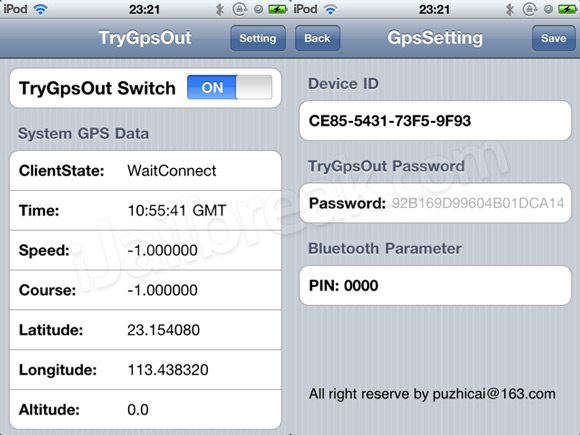
Thanks to a new tweak that was recently released into Cydia called TryGPSOut. It is now possible to transmit the iPhone’s GPS data to another iDevice through Bluetooth.
Say for example you are going on a roadtrip with a few of your friends and one of your friends has an iPad. You can say goodbye to a conventional map, and share your iPhone’s GPS data with the iPad. Letting you take advantage of the large display the iPad has to offer while still being able to navigate thanks to your iPhone’s GPS data.
If you are interested in the TryGPSout tweak you can find it through the Cydia Store for a price of $1.00. Let us know what you think of the TryGPSout tweak in the comments section below…
E2EK1EL
Amazon Kindle Fire review: It’s no iPad killer, and that is why it will succeed
Amazon has been a leader in the eBook reader space since it first introduced the Kindle eReader in November 2007. At that point in time, the Kindle had a 6-inch E Ink display that supported just four shades of gray, it included 250MB of storage that could accommodate about 200 eBooks, and it retailed for $399. For the first six months or so, Amazon couldn’t keep the device in stock — it was a smash hit.
Since then, Kindles have gotten thinner and lighter, and the current-generation model features a dramatically improved E Ink Pearl display and 2GB of storage. Amazon’s Kindle can now be had for as little as $79. A second model with a touchscreen display and twice the memory starts at just $99, and its battery lasts for up to two months on a single charge. Amazon doesn’t share sales volumes of its Kindle devices but the company is widely believed to be among the top eReader vendors in the world as it teeters between the No.1 and No.2 spots alongside Barnes & Noble.
But eReaders will only take the company so far.
Amazon has been a leader in the online retail space for quite some time, and its line of Kindle eReaders represents its first foray into the hardware game. EBooks are big business for Amazon, but its more recent service additions have also been gaining traction. With new options for purchasing and streaming music and movies, customers had to rely on third party devices — computers, connected TVs, set top boxes and smartphones — to consume this new wave of Amazon content. But why not make it all available on a single Amazon-branded device that picks up where the Kindle left off?
The tablet market posed an amazing opportunity for Amazon. I can’t even recall the last time a market segment saw so much hype and so few success stories, and Amazon identified an opportunity to succeed where others were failing. Instead of building hardware that merely served as a platter on which to serve the same software countless other vendors were unsuccessfully banking on, Amazon would build an end-to-end experience that covered hardware, software and content. After all, the only other vendor whose tablet offering addresses all three of these crucial areas of the user experience seems to be doing pretty well in the tablet space it redefined in early 2010.
Instead of setting out to build an iPad killer, Amazon set out to build a Kindle Fire.
The term “iPad killer” seems to describe any tablet launched by a popular vendor that cannot draw traffic to a news site unless said site includes a mention of Apple’s iPad in the headlines of stories written about said tablet. That’s really the only discernable link I’ve found between all of the slates that have been deemed iPad killers thus far. Another attribute most of them share, unfortunate though it may be, is that they don’t sell particularly well. There have been a few notable exceptions but in general, it seems these tablets are not well received by consumers or by enterprise customers.
If an iPad killer is a tablet that doesn’t grab people’s attention and often doesn’t sell particularly well, then the Kindle Fire is most certainly not an iPad killer.
Leading up to Amazon’s Kindle Fire, media tablets had for the most part been ill-conceived devices that were seemingly rushed out the door in an effort to capitalize on the hype surrounding the iPad. This strategy is not uncommon in business but in this particular case, companies forgot a key ingredient that drives competition: differentiation. With high price points, similar hardware and lackluster first-generation software (Honeycomb was Google’s first attempt at a tablet OS), the bulk of the iPad’s competition had very little to offer the common consumer that might distinguish it from the iPad in a positive way.
The Kindle Fire is a different beast.
Amazon attacked the tablet market on two fronts. First, it offered differentiation. Google’s Android operating system powers the Fire, but one wouldn’t know it to look at the device. Amazon used the open source Android OS as the framework on which it built its own unique user experience. It will continue its own development of the platform independent of Google’s future builds, and it maintains its own ecosystem outside of Google’s. Amazon has its own app store and its own suite of services.
The other piece to the Kindle Fire puzzle is pricing. At $199, Amazon’s tablet is $300 cheaper than the entry-level iPad and $630 less expensive than the 64GB model with embedded 3G. This was a very smart move by Amazon. The company will release more expensive models in the future — BGR exclusively reported preliminary details surrounding a 10-inch model due to be released next year — but Amazon’s first effort hits an amazing price point that creates a new space in the tablet market. It doesn’t compete with the iPad any more than a 32-inch flat panel Vizio TV competes with a 60-inch Samsung model. It’s a completely different animal.
I have read a number of Kindle Fire reviews — and there were plenty to choose from — that went to great lengths to compare Amazon’s tablet to the iPad. While these comparisons sometimes made for compelling reads and even more compelling headlines, they were not very useful. These devices are both tablets, yes, but to liken one to the other is as useful as likening a Mercedes S Class to a Hyundai Sonata. Both vehicles will get you from A to B, but in reality they serve very different purposes.
The S Class is designed to attract a certain type of customer. It offers utility, luxury and a driving experience that is the result of decades of evolution and many tens of millions of dollars in research and development. The S Class is designed to be seen. It outclasses and outperforms much of the competition, but it is about form as much as it is function. It is also assembled from high-end parts and materials, and it carries a relatively steep price tag to match. You see hundreds of them everywhere you go in metropolitan areas, but unless you have expendable income to throw around, you probably won’t buy one yourself.
The Sonata is designed to make a well-styled, capable sedan accessible to the masses. It looks more refined and performs better than other cars in its price range, and it also offers standard features that competing models do not. Even still, it doesn’t pretend to be an S Class and it most certainly doesn’t set out to kill the S Class.
The Sonata’s body isn’t quite as sleek and sophisticated as the Mercedes sedan, and it doesn’t come with nearly as many standard features. Its interior is also much more modest, forgoing supple leather and expensive woods in favor of more pedestrian materials. It won’t accelerate as quickly, it won’t corner as surely and it probably won’t turn any heads. It is a phenomenal value, however, and it touts a build quality and features that are anything but common on such an affordable car.
After using the device for about a week and a half now, I believe Amazon’s Kindle will succeed where others have failed. The hardware is good but not great. The soft-touch materials are comfortable in the hand but the 4,400 mAh battery that hides within the device makes it a bit too heavy for prolonged reading without resting the tablet on a table or leg. The software is good but not great. It has a nice, simple interface that a wide range of users will be able to navigate easily, but it is not refined. The performance is good but not great. Many functions are fluid, as is game play and video playback, but there are often of hiccups and stutters while opening certain apps and performing other functions.
What did you expect? It’s a Sonata.
At $200, the Kindle Fire is a fantastic buy. It is intuitive and capable, and the integration with Amazon services is well-done. The home screen is divided into four sections: a status pane across the top that displays notifications, the time, Wi-Fi status and battery charge, and it provides access to settings; a menu section that allows users to navigation between different core features such as the book reader, music player, apps menu and video player; a large area that lists all recent apps and books in a cover flow-like stream; and a favorites section where users can pin their most frequently accessed apps and books.
Each integrated app — Books, Music, Video and so on — is split into two sections that can be toggled at the top of the screen. The first is “Cloud,” which displays a list of icons on the shelves beneath it that represent all of the user’s content stored on Amazon’s servers. The second is “Device,” which lists locally stored content. There is also a link to Amazon’s store in the top right corner of each page. While it is all too easy to spend money on the Kindle Fire, I love how well Amazon’s services are integrated into each app.
While on the front page of the Books app, a single tap on an icon opens the book of my choice while a single tap on the always-visible store link lets me search, browse and purchase books with ease. The Music app lists all of my content available for playback, and then another Store link takes me to Amazon’s music shop where I can purchase albums or individual tracks. The Video app offers a similar experience, but it also offers integration with Amazon Prime video streaming, Amazon’s Netflix-like service that provides unlimited access to streaming movies and TV shows. Don’t expect to find many new blockbuster movies in there, but the catalog is deep enough to provide a decent range of content.
Amazon’s apps page adheres to the same intuitive format. Apps are organized across wood shelves and a link to the Amazon Appstore can be found in the top right corner. Users won’t have access to all of the content found in Google’s Android Marketplace, but that isn’t necessarily a bad thing. Like Apple’s iOS App Store, the Marketplace is packed with garbage. Amazon’s curated approach is appreciated and there is more than enough great content available. I also love that Amazon offers one new paid app for free each day. It makes checking the app store on a daily basis habitual, thus encouraging browsing and ultimately benefiting developers.
The web browser is another bright spot for the Kindle Fire. Amazon’s Silk browser is impressively quick thanks to technology that offloads much of the grunt work to remote servers. Heavy pages seem to take a moment to begin loading as a result, but once the cloud-based portion begins pushing content to the tablet, I find pages load faster than they do on other comparable devices.
The Kindle Fire is not an iPad killer. It doesn’t kill anything, in fact. What it does, however, is offer users a solid experience and a comprehensive catalog of services that make it easy to access existing content and to find new content. It is very, very easy to use, which is something that cannot be said of some other tablets. A young child will be flying around the UI in no time, and his or her grandparents likely won’t take long to figure it out either. Operation is relatively smooth for the most part, but prospective buyers should expect the occasional hiccup from first-generation software running on $200 hardware. Every computer, smartphone and tablet on the planet stutters from time to time, so this is hardly a big deal.
Amazon took its time with the Kindle Fire and it shows. There is plenty of room for improvement, but this first-generation tablet is an intuitive, functional tablet that is as cohesive as it is affordable. It was built as a gateway into the many web-based services Amazon now offers and it succeeds in its mission. It might not kill any Apple products on its way to your door, but I’m sure the media will find plenty of new Apple killers in the new year to draw your clicks. In the meantime, the Kindle Fire is a clear winner that will likely find itself atop Amazon’s list of best-sellers for quite some time.
E2EK1EL
New Chip Enables 1.5 Gbps Wireless Data Speeds
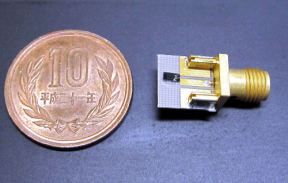
Rohm yesterday announced it has developed a chip that reached wireless data transmission speeds of 1.5 Gbps, reports TechCrunch. The company also said speeds of 30 Gbps will be possible in the future.
The semi conductor device uses terahertz waves for data transmission, has a micro antenna attached to it and is 2cm long and 1cm high (size of the module). Rohm developed the technology in cooperation with a research team at Osaka University.
The chip is expected to cost just 'several hundred yen' or several American dollars to produce. Current terahertz-based wireless chips cost millions of yen to produce, are 20cm squared, and have a top speed of just 0.1 Gbps, according to the Nikkei.
Of course, it will likely take several years before this technology is widely available.
(Very nice)
The new update fixed the so called bug from the previous update, that took away the stars.
E2EK1EL
Investors Value Apple's Innovation Process at $0
After analyzing AAPL and speaking with dozens of fund managers, Horace Dediu of Asymco believes that Apple's innovation process is being valued at $0.
The consensus is that the value of future, unknown products is zero. Not only that but the probability that there will be any products at all is equally zero. Not only that but whatever Apple does to create new products is not perceptibly valuable. The company is simply the sum-of-the-product-parts and nothing more. Cash flows from current products can easily be shown to be more than the current valuation so even these products are deeply discounted. If and when a new product shows up, it will be considered and maybe if it shows promise, the stock will reflect that, briefly.
Dediu suggests that Apple is not being valued a process company because people don't believe predictable success in product development is possible. Innovations are perceived as valuable but an innovation process isn't believed to exist. If it did then it would be measured and valued.
Hit the link below to read Dediu's full analysis and examples of how this thinking has affected the Apple stock price in the past.